I have always believed it to be the duty of a citizen to exercise and audit their rights as given to them by the constitution. Unfortunately, the Right to Information has remained one of the least exercised fundamental rights in India, at least on a per-capita basis. This is despite it's well-known role in democratic transparency and accountability.
Over the past several years, I have utilized the RTI Act on multiple occasions to seek information related to the management and financial health of certain institutions which I felt were often ignored or seemed unusually opaque in nature. My interest was also in auditing their compliance of RTI itself, especially if that office didn't recieve enough of them on a regular basis. IIT Madras though was not an institution I ever bothered looking into. I happened to blindly believe that they were one of the most transparent and law-abiding institutions in the country. Well, at least until very recently. And boy was I wrong.
The questions which I sent to the IIT-M BS office (being their Alumni) were quiet simple on the face of it. Very commonplace. Banal even. What I asked them was essentially two-fold:
- Provide the Annual Financial Statement of the Online BS Degree Program for the previous four financial years (21- 22, 22- 23, 23- 24, 24- 25)
- Provide the employee headcount for the same four years.
Honestly, I expected to get back their reply to this without a fuss. No one would have ended up even hearing about it, let alone read my blog. But to my absolute surprise the way it was handled was a complete mess, to say the very least.
Firstly, for the uninitiated, the RTI Act 2005 mandates that a public authority must respond to an RTI application within 30 days of its receipt. They must provide the information available to them except only in specific cases. These institutions are required to appoint Public Information Officers (PIOs) as necessary to respond to these questions on time. Flouting these rules carries penalties and disciplinary action for the PIOs.
The PIO responsible of answering my query in this case happened to be the Chairman of the Centre for Outreach and Digital Education (CODE) which the Online Degree Programme is a part of. He is without doubt in possession and control of the information I requested. And all he had to do was provide it.
Surprisingly, likely in an effort to deny me this information or at least make it as difficult as possible for me to aqcuire it, the PIO replied on 3rd Feb with an invitation for a physical inspection of documents at the BS Office. This came with the excuse that the information I requested was not readily available to him. This is of course totally ridiculous on multiple levels. Firstly, parts of the information are already available for everyone to see on the IITM website itself. The suo moto disclosure of the Institute's cash account statements is well known. He was required to send me whatever information that was immediately available to him even if it only meant partially answering the question. Secondly, an inspection means a scrutiny of volumnious documents at the lowest levels which would just end up digging their hole deeper.
So why would he do that? The only reason I can think of is to make it as difficult as possible for a person to get that information from them, hoping that they would likely feel intimadated, inconvenienced, and would give up their efforts to pursue it any further. Surely though, they had to know that sooner or later someone would show up and actually accept their offer, right?
Clearly, they were never prepared for that. As I already worked in a lab in campus, attending their inspection was not an issue for me. Unluckily though, they invited me on the 11th of February 2026 which happened to be a day which I was unavailable on. So naturally I asked them to rescedule it to an earlier date. Now this was exactly when they totally freaked out.
Someone from the BS office tried to reach me on my phone but I happened to be on a flight at that moment. But they wasted no time. They instead quickly called up a senior faculty member who knew me and urged them to ask me if I had any 'grievences' with them. This was wrong in so many ways. Firstly, the fundamental right to privacy does not allow the CPIO to reveal the identity and personal information of an RTI applicant to anyone unrelated to actually answering the query itself. Secondly, this was also a very unethical and immoral tactic of creating social pressure and increasing the sense of intimidation.
Not only that, their concern regarding my potential 'grievences' with them definitely did not come from a pure heart but was instead carefully calculated. Several judgements from the Central Information Commission (CIC) clearly state that RTI is not a means of redressing grievances, and their lawyer obviously knew this too. If I admitted to such a thing, this would have given them easy grounds to throw out my application instantly. But unfortunately for them, I knew this too.
With this tactic having failed, the PIO immediately sent me an invitation, indirectly through a colleague of mine, to meet the Associate Chair of CODE in person the very next day (5th Feb). As always, I had my senses in check and I told them to send me a formal email with the details of the meeting. I totally expected them to chicken out but to their credit they did email me. They emailed me an invite to meet on my personal email which they could have only have got from my RTI application (🤣).
Still, being the chivalrous gentleman that I am, I agreed to meet them and also threw in an excuse that I was assuming that the subject of our meeting would be to schedule the date of my inspection. Without further thought on their part, they quickly told me that this was just a casual conversation with me being an alumni and all. Well, in that case naturally they should have invited me on my alumni email id, right? But they didn't.
So the meeting did happen. The conversation was very much about my RTI application and not only was the PIO (Chairman of CODE) and the Assoc. Chair present, but also was the Joint Registrar (RTI) of the Institute and a senior official in charge of the BS programme. They painfully tried to explain it to me how their current accounting practices meant that the degree programme did not have a separate financial statement and also how it would take unreasonable effort for them to provide me their documents. I was not buying any of it. These were again well prepared tactics to convince me to rescind my application. They also asked me again about my 'grievences', about my reasons of asking such questions, and how the only people I would be hurting with my unnecessary prodding were the lower-income students of this programme. They even kept asking me if there was any way that my queries could be resolved outside of the RTI process. Was this an attempt to frame an extortion demand by me? Only they would know.
Regradless, I left that meeting feeling quiet dissapointed with their approach and attitude. I mean, how bad their state of affairs would have to be for them to break laws and go to such lengths to avoid answering my simple questions? I was also very surprised at how unprepared they were for this. I still hoped that they would get back to me with the answers sooner rather than later. But they haven't.
With more than a reasonable amount of time having passed since then, I am left with no choice but to file my First Appeal with the First Appallate Authority (FAA) of the Institute, which in this case happens to be the Dean of ICSR. Given the circumstances above, it is clear to me that the PIO has not only denied me information, but also been non-cooperative, created obstructions and demonstrated malafide intent. Even one of these things would likely be enough for the FAA to rule in my favour and provide grounds for disciplinary action against the PIO. I am quite confident that no one from IIT-M is going to refute any of my statements, because they know it's true and that I have the evidence to back it up. Still, I am hopeful that the FAA will do the right thing and uphold the law and also create a precedent that will help fix the management, accounting and RTI compliance practices of the Institute for good. I will update this blog in time on how that goes.
Let me come back to why I submitted these particular questions in the first place. As I said before, the cash accounts of CODE (NPTEL & BS) are already publicly available. These account statements do tell you a lot but they don't tell you everything. For example, they don't really tell you what physical assets they have and how many liabilities such as loans they have. They also don't tell you their expense on payroll and basically their overall financial health. That's exactly why you need an Annual Financial Statement (AFS) to understand the full picture.
Why don't we once go through what we already know?
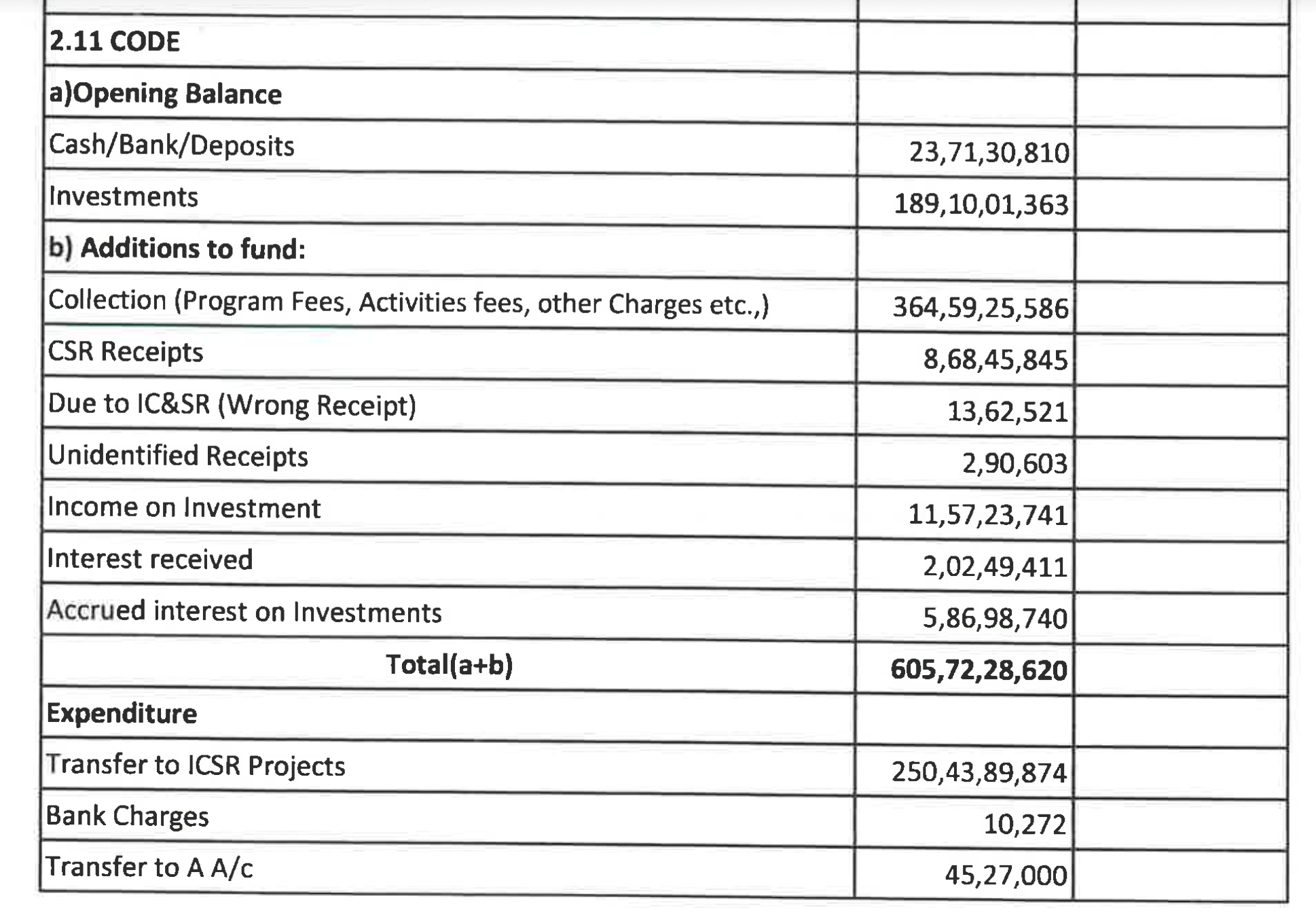
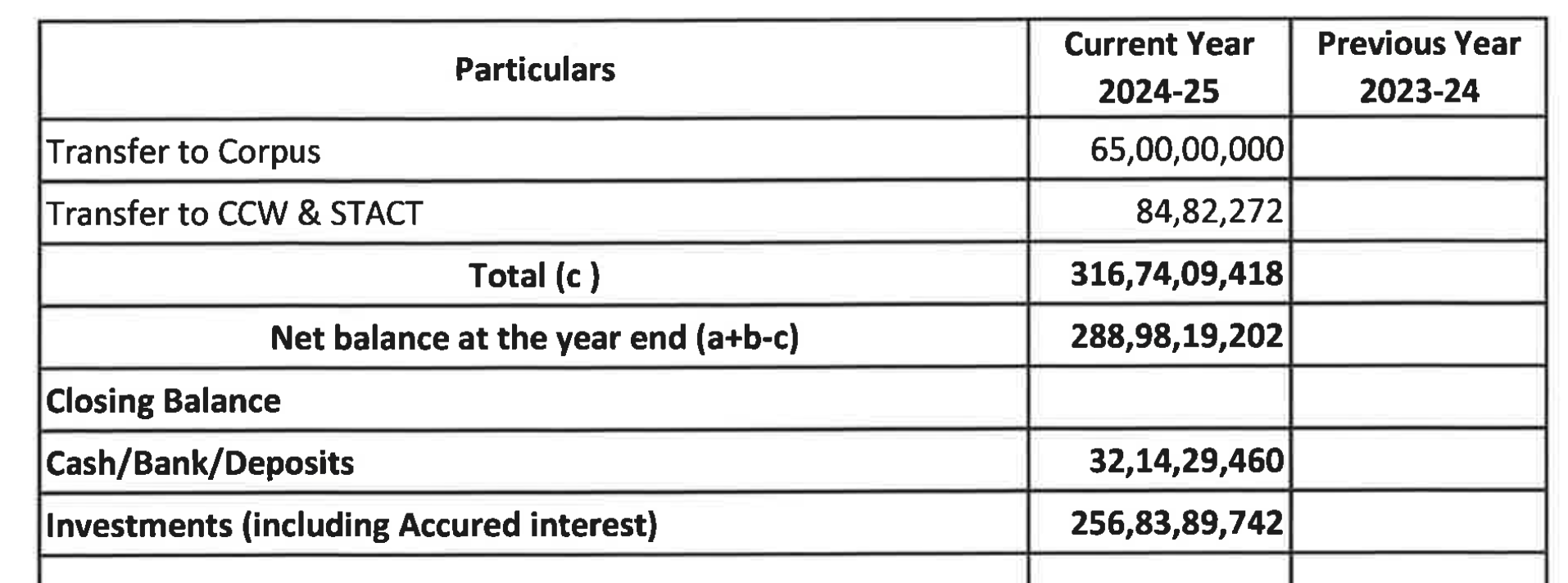
Essentially, CODE earned 364.6 crores from students in 2024-25 but spent at most only 250.43 crores for them. This leave over 110 crores of pure surplus from operational income from what I can tell.
By the end of the year, they were left with investments to the tune of 256 crores to their name. This is other than the 32 crores of cash in hand. They further sent about 65 crores back to the Institute. This is money that the Institute will likely spend at its discretion. Money from say NPTEL students may be spent on building new infrastructure or buying cars and buses that they will never get to see let alone use.
Let's look at only the BS Data Science account for a moment.
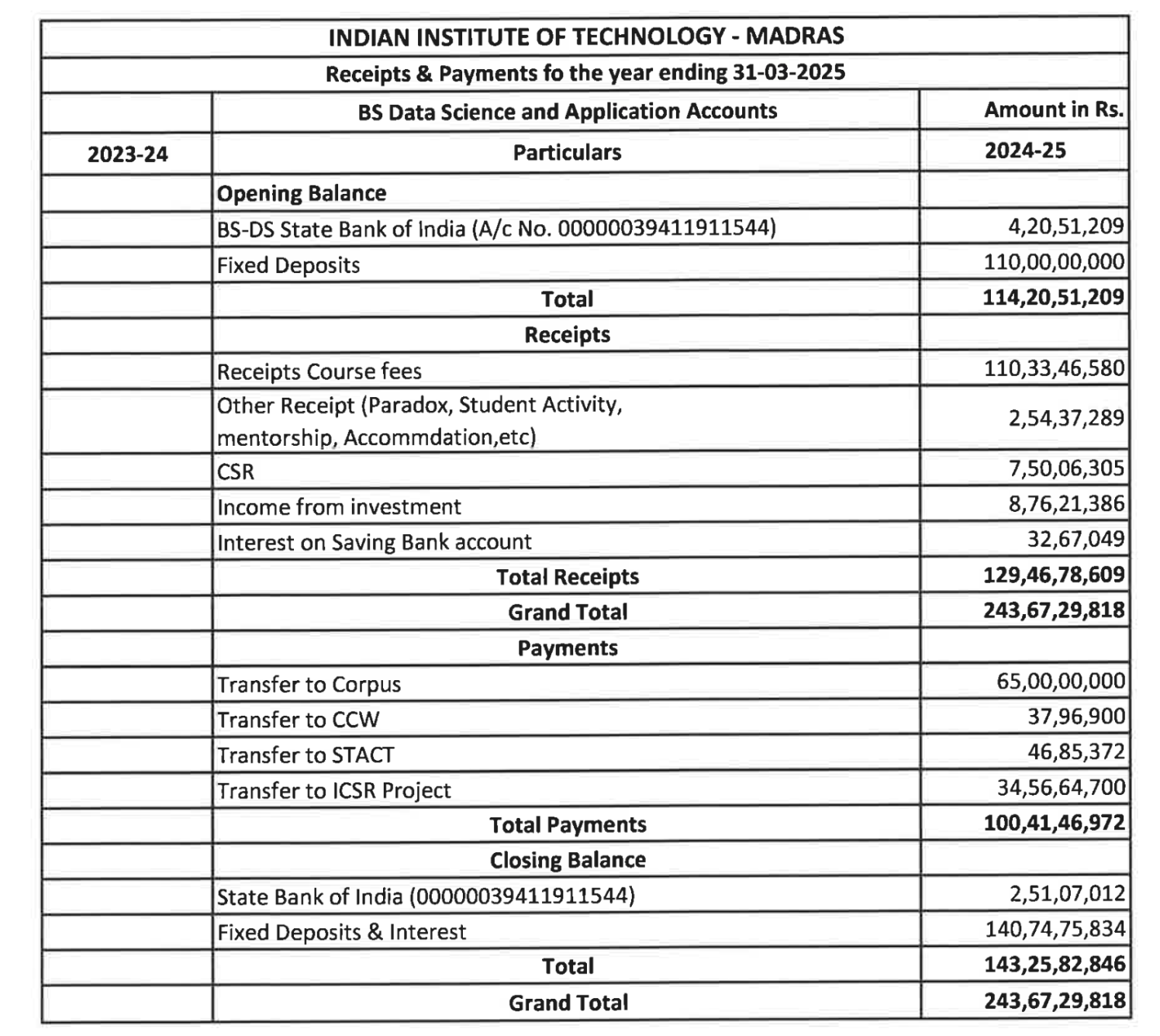
It looks like they earned about 113 crores Data Science students but only spent a measly 35 crores or so on them. It is also not clear if the 7.5 crores of CSR funds are being fully utilized. At least this is what I can glean from these statements. Again, I could be wrong but that's exactly why I want to see their AFS.
What should they do with this surplus, you may ask? Well they could do a whole lot for the BS students which would greatly improve what they get for their money. For example, they could create physical centres, labs and facilities in various major cities exclusively for online students. They could provide GPUs to every Deep Learning student if they wanted to. They could fund research labs in IIT-M and make them hire BS students to work in them. They could start grants and funds for startups and projects by BS students. Hell, I almost funded a startup by a BS student myself.
Imagine if they had a research travel grant for BS students that published papers in International conferences. I know that I and several others would have immensely benefitted from it. Unfortunately, the management seems more than happy to put that money in Fixed Deposits and sit on it or donate it to the Institute than do anything of real lasting value with it for their students.
Anyway, I am an Alumni now, and this money won't benefit me. Still, I hope that the current students of this programme realize what they are potentially missing out on and loudly demand their fair share. Also, having experienced the attitude of this management first hand and being essentially a victim of their law breaking definitely feels no good. I hope the FAA will do the right thing and the students will wake up to see their reality. My only intent is to improve the Institute and make it better for everyone that funds it, be it the students or the taxpayers. I hope this work of mine will help in that regard.